Preparing for midterms, finals, or standardized tests can feel overwhelming. Students are often tasked with reviewing hundreds of pages of lecture notes, textbook chapters, slide decks, and past assignments under tight deadlines. Traditional study methods—such as passively rereading highlighted notes—are often inefficient and lead to low memory retention when exam pressure hits.
Artificial intelligence has completely transformed how students prepare for exams. Modern AI exam study assistants can break down complex syllabi, summarize lengthy course materials, generate custom practice quizzes, build automated flashcard decks, and provide step-by-step tutoring tailored to your exact learning style.
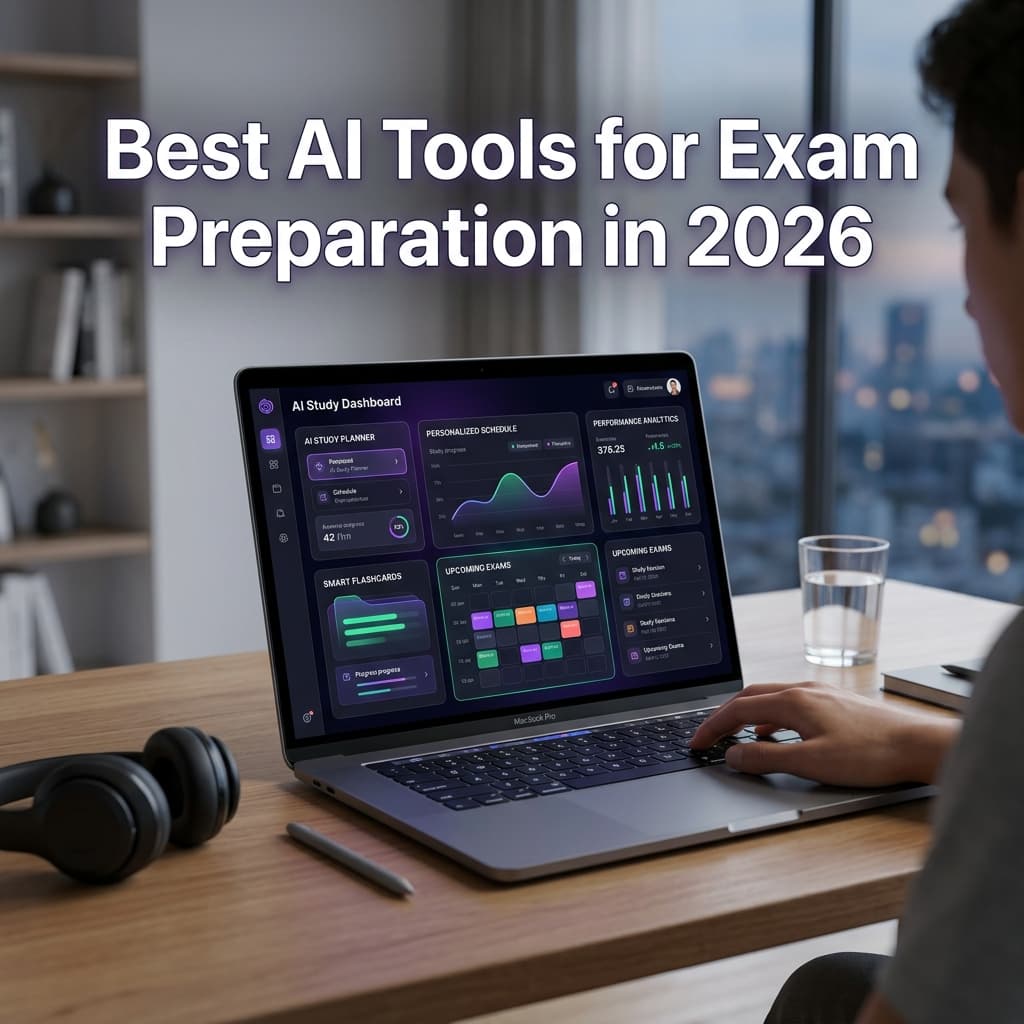
In this guide, we evaluate the best AI tools for exam preparation in 2026. Whether you need an all-around AI tutor for college exams, a tool to convert lecture PDFs into mock tests, or a specialized STEM solver, this guide covers the top free and paid AI revision platforms.
Quick Answer: The best AI tools for exam preparation depend on your specific study needs. ChatGPT serves as a 24/7 interactive tutor and practice question generator, NotebookLM is unmatched for studying directly from personal notes and PDFs without hallucinations, Quizlet and Knowt power flashcard generation and quiz revision, while Khanmigo and Wolfram Alpha offer guided problem-solving for STEM and quantitative subjects.
Ready to build your complete student AI stack? Explore our dedicated guides across the student learning journey:
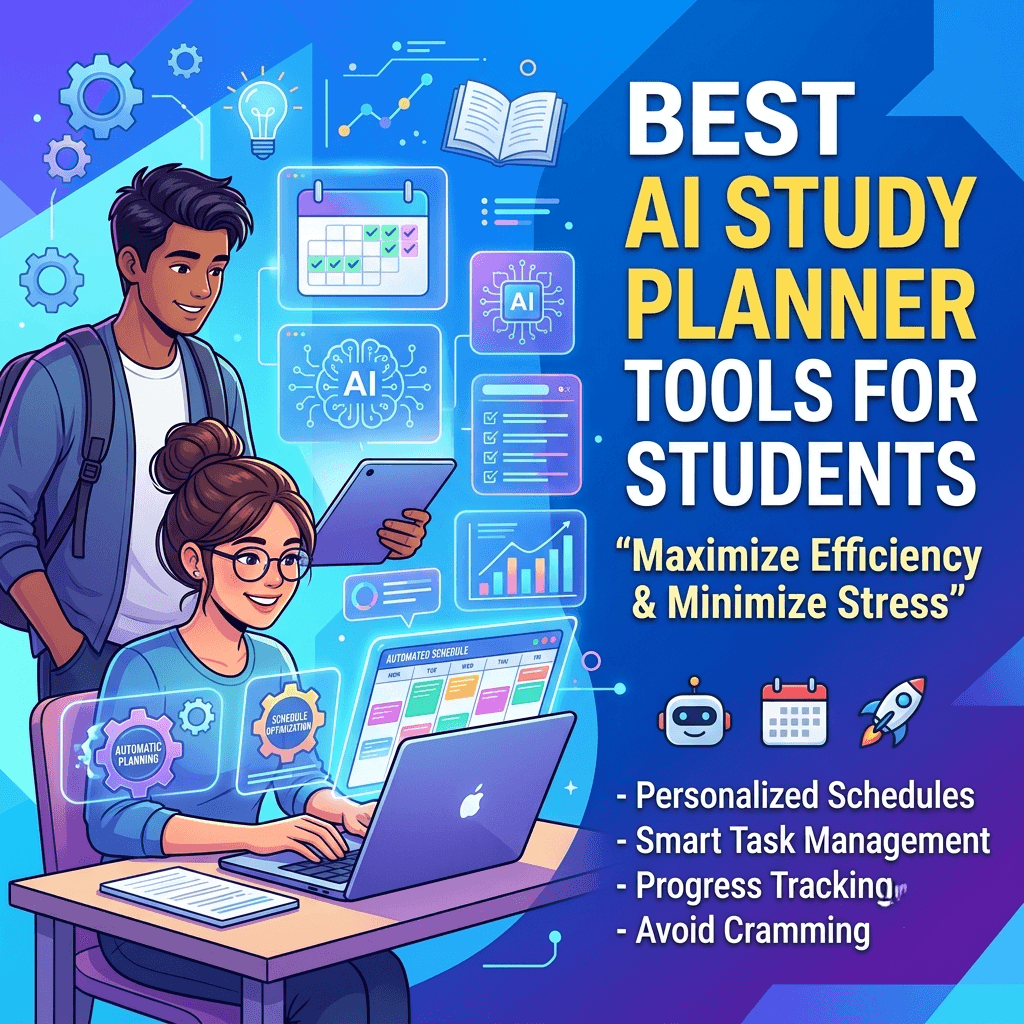
→ Best AI Study Planner Tools for Students
→ Best AI Flashcard Generators for Students
→ Best AI Homework Helpers for Students
→ Best AI Note-Taking Tools for Students
→ Best AI Research Tools for Students
1. Introduction: Best AI Tools for Exam Preparation
The best AI tools for exam preparation can help students create study plans, summarize course material, generate flashcards, create practice questions, and identify weak areas before an exam.
Rather than replacing critical thinking, artificial intelligence acts as a personalized exam study assistant. Instead of spending 10 hours creating manual practice questions or trying to decode dense textbook jargon alone, students can use AI to instantly surface key concepts, test their recall, and structure their study time efficiently.
By leveraging active recall and spaced repetition—the two most effective, evidence-backed study strategies—AI study tools ensure that your exam revision focuses on what you actually need to learn, rather than what you already know.
2. How AI Helps Students Prepare for Exams
Exam preparation requires more than just reading over lecture notes. Effective studying requires transforming passive course materials into active testing tools. Here is how AI tools enhance every stage of the revision process:
- Creating Personalized Revision Schedules: AI tools organize your exam topics into structured daily study goals based on your exam date and current knowledge level.
- Summarizing Long Study Materials: AI distills hundreds of pages of textbooks, lecture slides, and PDF notes into concise key takeaways, core definitions, and high-yield summary sheets.
- Generating Practice Questions & Mock Exams: AI algorithms turn raw notes into multiple-choice questions, short-answer prompts, and essay topics that mirror actual exam conditions.
- Creating Flashcards for Active Recall: AI tools extract core concepts from your materials and convert them into Q&A cards for spaced repetition review.
- Explaining Difficult Concepts: When a textbook definition feels confusing, AI tutors explain complex ideas using simple analogies, visual breakdowns, or alternative frameworks.
- Identifying Knowledge Gaps: By tracking your accuracy across practice quizzes, AI pinpoints specific weak topics so you can spend your remaining revision time on concepts that need improvement.
3. Best AI Tools for Exam Preparation in 2026
Below are detailed reviews of the top AI exam preparation tools available for students in 2026, categorized by their primary study strength.
1. ChatGPT — Best All-Around AI Exam Tutor
ChatGPT (powered by GPT-4o) remains the most versatile AI study assistant for exam preparation. It can generate customized practice exams, explain difficult concepts in multiple difficulty levels, roleplay as an oral exam examiner, and create detailed study schedules.
Best Features:
- Interactive Socratic tutoring mode
- Customized practice question generation from pasted notes
- Concept explanations tailored to any grade level or background
- Real-time oral exam preparation via voice mode
- Ability to process images of hand-written math problems or diagrams
Pros:
- ✅ Extremely versatile across all academic disciplines
- ✅ Free access tier available (GPT-4o mini / limited GPT-4o)
- ✅ Excellent for interactive conversational learning
- ✅ Can adjust difficulty based on user feedback
Cons:
- ❌ Can occasionally hallucinate facts if not grounded with source text
- ❌ Requires good prompting to produce high-yield exam questions
Best For: Students needing an interactive, 24/7 exam study partner for concept explanations and custom practice questions.
2. NotebookLM — Best for Studying From Personal Notes and PDFs
NotebookLM (developed by Google) is a source-grounded AI study assistant designed specifically to analyze uploaded documents. Students can upload up to 50 source files—including PDF textbooks, lecture slides, Google Docs, research papers, and audio recordings—and ask questions grounded exclusively in those sources.
Best Features:
- 100% source-grounded answers with direct inline citations to uploaded PDFs
- Instant generation of study guides, briefing documents, and FAQs
- "Audio Overview" feature that converts lecture notes into a downloadable podcast conversation
- Zero risk of hallucinating facts outside your course syllabus
Pros:
- ✅ Completely free to use
- ✅ Strictly adheres to your uploaded course materials
- ✅ Excellent for dense humanities, law, biology, and history courses
- ✅ Provides exact page citations for verified studying
Cons:
- ❌ Does not feature built-in spaced repetition algorithms
- ❌ Limited to uploaded sources (does not browse general external web data)
Best For: College and university students who want to study directly from their professor's slides, notes, and required readings without outside distractions.
3. Quizlet — Best for Flashcards & Practice Tests
Quizlet is a leading digital study platform that incorporates advanced AI features like Q-Chat (an AI study coach) and automated practice test generation. It allows students to convert raw notes into interactive flashcards, matching games, and structured exam preparation sets.
Best Features:
- Instant flashcard creation from notes and PDFs
- Q-Chat AI study coach for conversational self-testing
- Automated practice test generation with multiple choice and written questions
- Massive library of student-generated study sets across subjects
- Cross-device syncing and mobile apps
Pros:
- ✅ Highly intuitive interface designed for students
- ✅ Combines active recall with multiple study modes
- ✅ Gamified review options for lower-stress studying
Cons:
- ❌ Advanced AI features require a Quizlet Plus subscription
- ❌ User-generated decks must be checked for accuracy
Best For: Students who learn best through structured flashcards, vocabulary drills, and multiple-choice practice tests.
4. Knowt — Best Free AI Study Platform
Knowt is a free alternative to Quizlet that offers robust AI features for exam preparation. Students can import Quizlet sets, upload lecture notes, or paste documents, and Knowt's AI will automatically build flashcards, practice quizzes, and interactive study guides.
Best Features:
- Free AI flashcard and quiz generator from uploaded PDFs or notes
- Built-in spaced repetition study mode
- Free import tool for existing Quizlet study sets
- AI lecture video summarizer and quiz maker
Pros:
- ✅ 100% free core AI features
- ✅ Clean, student-focused design
- ✅ Great spaced repetition tracking
- ✅ Supports PDF, video, and text inputs
Cons:
- ❌ Slightly smaller community library compared to Quizlet
- ❌ AI quiz question formatting may occasionally require minor manual edits
Best For: Budget-conscious high school and college students looking for free AI flashcards, practice tests, and note summaries.
5. Khanmigo — Best for Guided Socratic Learning
Khanmigo (developed by Khan Academy) is an AI study tutor designed specifically around Socratic learning principles. Rather than giving students direct answers to homework or exam questions, Khanmigo asks guiding questions to help students work through complex problem steps independently.
Best Features:
- Socratic tutoring interface that guides without spoiling answers
- Subject-aligned prep for AP exams, SAT, ACT, and math courses
- Instant feedback on problem-solving steps
- Safe, educational AI environment tailored for students
Pros:
- ✅ Outstanding for deep conceptual understanding
- ✅ Prevents reliance on quick answers, building true exam readiness
- ✅ Integrated with Khan Academy's structured video curriculum
Cons:
- ❌ Requires a small monthly donation/subscription in some regions
- ❌ Less suitable for fast text-summarization of external documents
Best For: K-12 and AP students who need step-by-step guidance in math, science, and standardized test prep.
6. Wolfram Alpha — Best for Math and STEM Exams
Wolfram Alpha is the definitive computational intelligence engine for STEM exam preparation. Unlike standard LLMs that predict text, Wolfram Alpha computes mathematical answers using curated algorithmic data, offering step-by-step problem breakdowns for calculus, algebra, physics, and chemistry.
Best Features:
- Step-by-step solutions for equations, integrals, derivatives, and matrix operations
- Interactive graph plotting and chemical structure modeling
- Exact mathematical computation with zero hallucination risk
- Expert-level coverage of physics, chemistry, engineering, and statistics
Pros:
- ✅ Unrivaled accuracy for complex mathematical equations
- ✅ Step-by-step solutions highlight exact formula applications
- ✅ Essential tool for engineering and physics exams
Cons:
- ❌ Pro plan required for full step-by-step solution views
- ❌ Not designed for essay writing or humanities study
Best For: Engineering, computer science, physics, mathematics, and chemistry students preparing for problem-solving exams.
7. Quizizz AI — Best for Gamified Practice Quizzes
Quizizz AI allows students and teachers to convert documents, web pages, or topic prompts into interactive, gamified practice quizzes. It provides immediate feedback, answer explanations, and flashcards to help reinforce tricky exam concepts.
Best Features:
- One-click AI quiz generation from PDFs, URLs, or notes
- Multiple question types (multiple choice, fill-in-the-blank, open-ended)
- Gamified solo study modes with instant explanations
- Adaptive difficulty modes
Pros:
- ✅ Makes repetitive exam review engaging and fun
- ✅ Fast question generation
- ✅ Useful for quick self-assessment sessions
Cons:
- ❌ Primarily designed around short quiz formats rather than essay prep
- ❌ Free tier has limitations on AI question generation limits
Best For: Students who want engaging, bite-sized practice quizzes to test recall before quizzes and midterms.
8. StudyFetch — Best for Converting Lecture Material into Study Packs
StudyFetch is an all-in-one AI study platform that converts course materials into comprehensive study packs. You can upload lecture recordings, PDFs, PowerPoints, and notes, and StudyFetch's AI tutor ("Spark.E") will generate interactive flashcards, practice tests, notes summaries, and real-time chat assistance.
Best Features:
- Audio and video lecture transcription into exam study guides
- Interactive AI study assistant ("Spark.E") trained on your materials
- Automated practice exams with dynamic scoring
- Integrated study material management
Pros:
- ✅ Excellent for converting raw lecture audio/video into written review guides
- ✅ High-yield study dashboard organizing all materials by course
- ✅ Interactive testing features keep study active
Cons:
- ❌ Premium tier required for full access to advanced AI features
- ❌ Processing large video files can take a few minutes
Best For: College students who want to turn recorded lectures, slides, and syllabus documents into automated study materials.
4. Best AI Exam Preparation Tool by Need
Choosing the right AI study assistant depends on what type of exam you are taking and where your study process needs support.
| Study Need | Best Tool | Key Advantage |
|---|---|---|
| Personalized concept explanations | ChatGPT | 24/7 conversational tutor with adjustable depth |
| Studying from PDFs & lecture slides | NotebookLM | 100% source-grounded with zero hallucination risk |
| Flashcards & spaced repetition | Quizlet / Knowt / Anki | Automated Q&A card generation & retention scheduling |
| Math, physics, & STEM calculations | Wolfram Alpha | Step-by-step computational accuracy |
| Practice quizzes & mock exams | Quizlet / Quizizz AI | Instant test generation with dynamic feedback |
| Free exam preparation | Knowt / NotebookLM | Full-featured AI note & flashcard tools at $0 cost |
| Study schedules & time blocking | AI Study Planners | Automated exam revision timetables |
5. How to Create an AI Exam Study Plan
To maximize your performance on exam day, you should combine your AI study tools into a structured study workflow.
For a complete breakdown of schedule-building algorithms, read our detailed guide on Best AI Study Planner Tools for Students.
Here is the step-by-step workflow to build an effective AI exam revision routine:
7-Step AI Exam Preparation Workflow
From raw syllabus to active exam mastery
6. Best AI Tools for Different Subjects
No single AI tool fits every academic discipline. Choosing the right AI stack tailored to your field of study accelerates learning:
Best AI Tools for Math Exams
Math exams require problem-solving practice rather than simple memorization.
- Primary Tool: Wolfram Alpha (for exact computational steps and graphing)
- Secondary Tool: ChatGPT / Khanmigo (for explaining underlying mathematical concepts and theorems)
- Study Strategy: Paste math problems you got wrong into ChatGPT and ask for similar practice problems to solve independently.
Best AI Tools for Science Exams (Biology, Chemistry, Physics)
Science exams test both memorization of terms and application of scientific principles.
- Primary Tool: NotebookLM (for grounding your revision in dense textbook chapters and lab reports)
- Secondary Tool: Knowt / Quizlet (for memorizing anatomical terms, chemical pathways, and formulas)
- Study Strategy: Use NotebookLM to create comparative tables between similar biological processes (e.g., Mitosis vs. Meiosis).
Best AI Tools for Language Exams
Language tests measure vocabulary, grammar rules, reading comprehension, and translation skills.
- Primary Tool: Anki / Quizlet (for vocabulary flashcards using spaced repetition)
- Secondary Tool: ChatGPT Voice Mode (for real-time conversational practice in foreign languages)
- Study Strategy: Practice conversing with ChatGPT in your target language while requesting immediate grammar corrections.
Best AI Tools for Engineering Exams
Engineering tests evaluate multi-step calculations, system mechanics, and technical diagrams.
- Primary Tool: Wolfram Alpha (for differential equations, linear algebra, and thermodynamics calculations)
- Secondary Tool: ChatGPT + Custom GPTs (for troubleshooting code blocks, circuit analysis, and structural mechanics)
- Study Strategy: Use ChatGPT to explain complex engineering trade-offs and code logic step-by-step.
Best AI Tools for Medical Exams (MCAT, USMLE, Nursing)
Medical board exams demand massive volumes of memorization paired with clinical reasoning.
- Primary Tool: Anki (with medical add-ons for spaced repetition)
- Secondary Tool: NotebookLM / StudyFetch (for indexing thousands of pages of medical lecture slides and clinical guidelines)
- Study Strategy: Build custom Anki flashcard decks from NotebookLM summaries to retain high-yield medical facts over month-long study periods.
| Academic Subject | Top Recommended Tool Stack | Primary Exam Study Focus |
|---|---|---|
| Mathematics & Statistics | Wolfram Alpha + ChatGPT | Step-by-step formula applications & problem sets |
| Biology & Life Sciences | NotebookLM + Knowt | PDF-grounded concepts & vocabulary flashcards |
| Languages & Linguistics | Anki + ChatGPT Voice | Spaced repetition vocabulary & spoken dialogue |
| Engineering & CS | Wolfram Alpha + ChatGPT | Computational mechanics, calculus, & code analysis |
| Medical & Pre-Med | Anki + NotebookLM | High-volume spaced recall & clinical case study prep |
7. How to Use AI for Exam Preparation Without Cheating
Using AI for exam preparation is meant to enhance learning, build deep comprehension, and sharpen recall skills. Academic integrity remains paramount. Using AI responsibly ensures you gain genuine knowledge that will serve you on test day.
✅ Responsible Ways to Use AI for Exam Preparation:
- Use AI to Explain Concepts: Ask AI to simplify dense textbook passages or break down multi-step processes into plain language.
- Generate Practice Questions: Use AI to build custom multiple-choice and short-answer quizzes based on your own notes.
- Review Your Own Notes: Upload your handwritten or digital lecture notes to check for missing definitions or conceptual errors.
- Test Your Understanding: Use Socratic AI prompts (e.g., "Quiz me one question at a time and evaluate my answers").
- Verify Information: Always cross-reference AI-generated summaries against your official course textbook or lecture slides.
❌ What to Avoid:
- Never submit AI-generated text as your own original work: Relying on AI to generate exam answers or take online tests for you constitutes academic dishonesty and violates honor codes.
- Don't blindly trust unverified AI outputs: AI models can hallucinate facts. Always verify facts, dates, and formulas against primary course materials.
8. FAQ Section
What is the best AI tool for exam preparation?
The best overall AI tool for exam preparation is ChatGPT due to its versatility in generating practice questions, explaining complex concepts, and adapting to student prompts. For studying directly from course PDFs and lecture slides without risk of hallucination, NotebookLM is the top choice.
Can AI create a study plan for an exam?
Yes. AI tools can analyze your exam syllabus, test date, available study hours, and weak topics to generate a customized, time-blocked study schedule. For a complete guide on dedicated planning tools, read our guide on Best AI Study Planner Tools for Students.
Can AI generate practice questions from my notes?
Yes. Platforms like NotebookLM, Quizlet, Knowt, and ChatGPT can instantly analyze uploaded notes, PDFs, or lecture slides and generate multiple-choice, fill-in-the-blank, and essay-style practice questions complete with answer keys.
What is the best free AI tool for studying?
NotebookLM and Knowt are two of the best free AI tools for exam preparation. NotebookLM provides source-grounded answers and audio overviews from uploaded PDFs at zero cost, while Knowt offers free AI flashcards, practice quizzes, and spaced repetition study modes.
Can ChatGPT help me prepare for college exams?
Yes. ChatGPT works as an interactive tutor. You can paste lecture notes into ChatGPT and ask it to quiz you on key concepts, explain difficult topics using simple analogies, or generate mock exams matching your professor's testing style.
Can AI turn lecture notes into flashcards?
Yes. Tools like Quizlet, Knowt, and RemNote use AI algorithms to extract key definitions, formulas, and concepts from lecture notes or PDFs and convert them into digital flashcard decks ready for spaced repetition review.
Conclusion: Mastering Exam Preparation with AI
Artificial intelligence has made exam preparation more structured, efficient, and interactive than ever before. By moving away from passive rereading and embracing AI-driven active recall, practice testing, and personalized study schedules, students can master complex course material in significantly less time.
To build a complete AI-enhanced study workflow:
- Start by organizing your notes with the Best AI Note-Taking Tools for Students.
- Schedule your revision timeline using the Best AI Study Planner Tools for Students.
- Build active recall study decks with the Best AI Flashcard Generators for Students.
- Get step-by-step problem support with the Best AI Homework Helpers for Students.
By using AI as an interactive study assistant rather than a shortcut, you can enter your exam room with confidence and achieve your academic goals.