Self-Awareness Exercises: Practical Daily Practices to Build Real Self-Awareness
What are self-awareness exercises? Self-awareness exercises are structured mental practices that help you observe your thoughts, emotions, and behaviors in real time without reacting automatically. They improve emotional awareness, decision-making, and behavioral pattern recognition through repeated observation and reflection.
Best self-awareness exercises include:
- Emotional labeling (naming your feelings precisely)
- Pattern-based journaling (“When X happened, I did Y”)
- Trigger tracking (identifying emotional triggers)
- Thought labeling (observing thoughts as mental events)
- Delay response technique (pausing before reacting)
- Daily self-reflection practice
- Mindfulness awareness pauses
How to improve self-awareness step by step:
- Notice your emotional state throughout the day
- Label emotions with precise language
- Track repeated behavioral patterns
- Identify emotional triggers
- Pause before reacting to impulses
- Reflect on actions at the end of the day
- Adjust behavior based on observed patterns
Most people assume self-awareness is something you “figure out” through thinking. In reality, it’s built through structured observation of your thoughts, emotions, and behavior in real time.
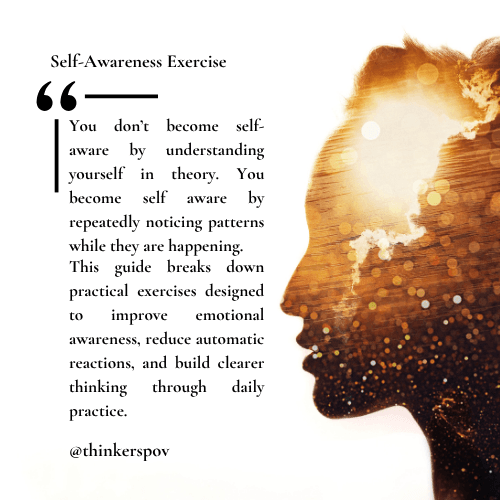
You don’t become self-aware by understanding yourself in theory. You become self-aware by repeatedly noticing patterns while they are happening.
This guide breaks down practical self-awareness exercises designed to improve emotional awareness, reduce automatic reactions, and build clearer thinking through daily practice.
What Are Self-Awareness Exercises and Why They Matter
Self-awareness exercises are structured practices that help you observe your thoughts, emotions, and behaviors without immediately reacting or justifying them.
They are designed to improve what psychology calls metacognition, the ability to observe your own thinking rather than being fully controlled by it.
At a practical level, these exercises help you:
- Notice emotional reactions earlier
- Identify repeated behavioral patterns
- Reduce impulsive decisions
- Improve clarity in stressful situations
- Build better control over attention and response
If you want a deeper breakdown of how awareness actually works in the mind, see the self-awareness in psychology framework.
Self-awareness is not built by insight alone. It is built by repeated observation.
Emotional Self-Awareness Exercises for Daily Life
Emotional self-awareness is the ability to recognize what you are feeling while you are feeling it, not after the reaction has already passed.
Exercise: Emotional labeling in real time
Several times a day, pause and name your emotional state with precision.
Instead of:
“I’m stressed”
Try:
“I feel tense because I think I’m being evaluated” “I feel irritated because I’m being interrupted” “I feel uncertain about the outcome of this situation”
This creates distance between you and the emotion, which reduces automatic reactions.
Why it works
When emotions are unnamed, they drive behavior unconsciously. When labeled accurately, they become manageable data instead of overwhelming signals.
For deeper patterns of emotional awareness, this connects directly to emotional self-awareness techniques and identifying signs of low self-awareness.
Journaling for Self-Awareness and Thought Clarity
Most journaling fails because it turns into storytelling. Self-awareness journaling is different. It focuses on observation, not explanation.
Exercise: Pattern-based journaling
At the end of the day, write one sentence:
“When X happened, I did Y.”
Examples:
- When I felt ignored, I stopped participating
- When I felt behind, I started switching tasks repeatedly
- When I was challenged, I became overly defensive
Do not explain why it happened. Just record the pattern.
Why this works
Your brain is good at creating stories after the fact, but weak at noticing patterns in real time. This exercise bypasses that storytelling mechanism.
If you want deeper reflection structures, combine this with self-reflection questions designed for behavior analysis.
Trigger Tracking Method to Understand Your Emotional Reactions
Triggers are situations that consistently produce strong emotional reactions. Most people experience them repeatedly without noticing the pattern.
Exercise: Trigger mapping
Pick one emotional reaction (anger, anxiety, frustration).
Then track:
- Situations where it appears
- People who trigger it
- Environments where it increases
Example
You may notice:
- Criticism triggers defensiveness
- Uncertainty triggers avoidance
- Being ignored triggers withdrawal
Why this matters
Triggers reveal blind spots in self-awareness. If a pattern repeats, it is not random. It is information.
This connects strongly with lack of self-awareness signs, where repeated reactions go unnoticed over time.
Self-Reflection Exercises to Understand Your Behavior Patterns
Self-reflection becomes powerful only when it focuses on behavior, not identity.
Exercise: Structured reflection
Ask yourself:
- What did I avoid today?
- When did I act automatically?
- Where did I react instead of choose?
You are not analyzing personality. You are observing behavior.
Example reflection
- I avoided replying to a difficult message
- I interrupted someone when I felt challenged
- I delayed an important task when I felt overwhelmed
Why this works
Behavior is observable. Identity is interpretive. Self-awareness improves faster when you focus on what you did, not what you think you are.
For deeper behavioral understanding, this connects to self-awareness examples in real-life situations.
Mindfulness Practices for Developing Present-Moment Awareness
Mindfulness is the practice of observing thoughts and emotions without immediately reacting to them.
Exercise: 10-second awareness pause
Several times a day:
- Stop for a moment
- Notice what you are thinking
- Notice what you are feeling
- Return to the task
No analysis. No fixing. Just observation.
Why it works
Most lack of self-awareness comes from automatic behavior. This exercise interrupts that automation long enough for awareness to appear.
It connects directly to self-awareness meditation techniques and emotional regulation training.
Cognitive Awareness Training Techniques Used in Psychology
Cognitive awareness is the ability to observe thoughts as mental events rather than truths.
Exercise: Thought labeling
When a strong thought appears, label it:
“I am having the thought that I might fail” “I am having the thought that this is unfair”
This creates distance between you and the thought.
Why it works
You are not your thoughts. You are the observer of thoughts. This distinction is the foundation of metacognition.
For deeper understanding, see self-awareness in psychology explained and how awareness levels influence thinking.
Self-Awareness Exercises for Improving Decision Making
Most poor decisions come from emotional urgency, not lack of information.
Exercise: Delay response method
When you feel an impulse:
- Wait 10–30 seconds before acting
- Observe if the emotional intensity changes
What this reveals
If intensity drops, the urgency was emotional, not logical.
Example
- Sending an angry message
- Making a rushed decision
- Reacting defensively in conversation
Why it works
Self-aware decision making happens when emotion and action are separated by awareness, even briefly.
This connects strongly to self-awareness examples in decision-making situations.
Daily Self-Awareness Routine for Long-Term Growth
Self-awareness is not built through isolated exercises. It is built through consistency.
Morning routine
- Set intention: “I will notice my reactions today”
- Identify one emotional pattern to watch
During the day
- Emotional labeling
- 10-second awareness pauses
Evening routine
- Pattern journaling
- Trigger reflection
Why it works
You are training awareness across time, not in isolated moments.
This links naturally to how to become more self-aware step-by-step and structured personal development systems.
Common Mistakes in Self-Awareness Practices
Most people fail at self-awareness not because they lack effort, but because they use the wrong type of reflection.
Mistake 1: Overthinking instead of observing Turning reflection into analysis creates mental loops, not awareness.
Mistake 2: Asking “why” too often “Why” produces stories, not truth. It increases rumination.
Mistake 3: Journaling without structure Unstructured journaling becomes emotional dumping.
Mistake 4: Ignoring behavior Focusing only on thoughts without tracking actions limits real awareness.
Why this matters
Self-awareness is not introspection. It is observation of patterns across time.
For related insights, explore signs of low self-awareness and why certain patterns stay hidden.
Final Idea
Self-awareness improves when you consistently observe your emotions, track behavioral patterns, and pause before reacting. These small daily exercises gradually reduce impulsive behavior and increase clarity in decision-making.
Self-awareness exercises work because they shift your attention from:
interpreting yourself to observing yourself
That small shift is what creates real psychological change.
Not more thinking. More seeing.
Frequently Asked Questions About Self-Awareness Exercises
What are the best self-awareness exercises?
The best self-awareness exercises include emotional labeling, journaling patterns, trigger tracking, mindfulness pauses, and thought observation techniques. These practices improve awareness of thoughts, emotions, and behavior in real time.
How do I become more self-aware daily?
You can become more self-aware by practicing emotional labeling, tracking your reactions, journaling daily behavior patterns, and pausing before responding to emotional triggers.
Can self-awareness be improved with exercises?
Yes, self-awareness can be improved through consistent exercises that train observation of thoughts and emotions. Over time, these practices strengthen metacognition and reduce automatic reactions.
What is the fastest way to build self-awareness?
The fastest way is combining emotional labeling with pattern journaling. This helps you recognize behaviors in real time and identify recurring emotional triggers quickly.
Why is self-awareness difficult?
Self-awareness is difficult because the brain creates automatic interpretations of experiences. People often confuse thinking about themselves with actually observing their behavior.
What is emotional self-awareness?
Emotional self-awareness is the ability to recognize and understand your emotions as they happen. It helps reduce impulsive reactions and improves emotional regulation.