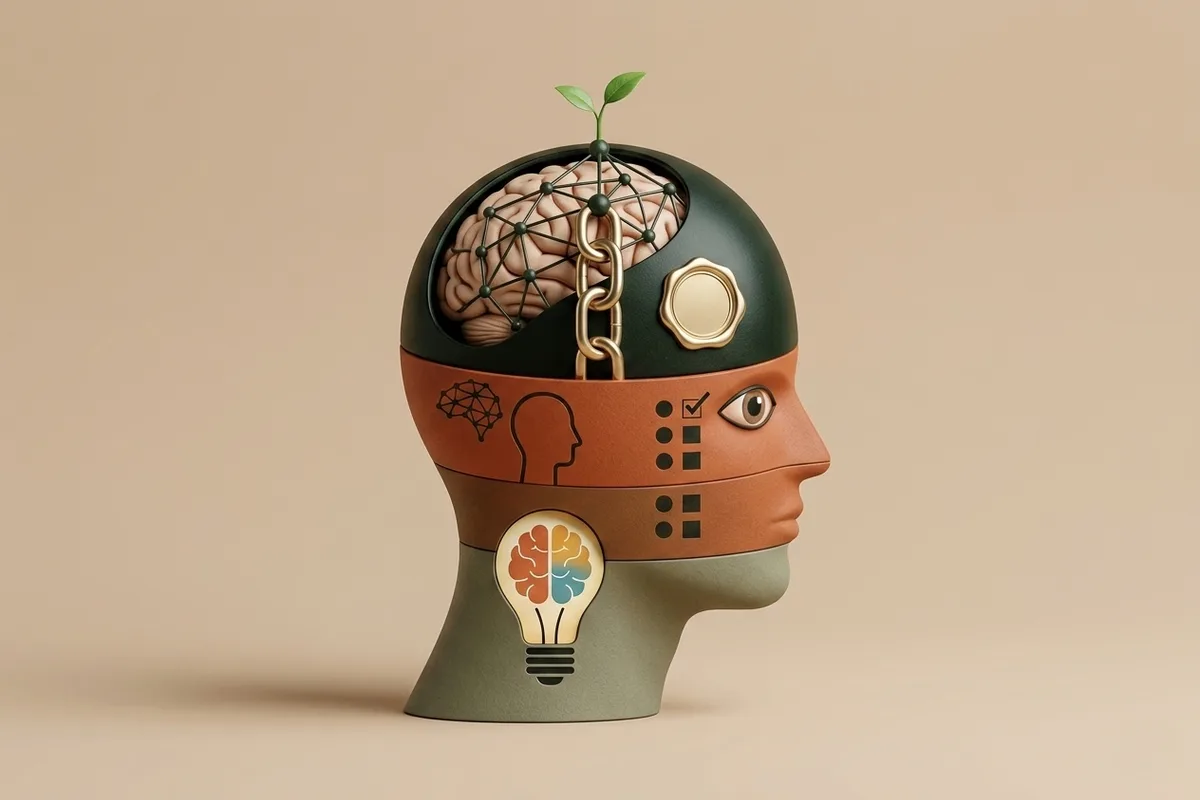
The gap between wanting to be different and actually becoming different is one of the most interesting problems in psychology.
I have wanted to wake up at 6am for three years.
Not casually. Not in a vague "that would be nice" kind of way. I mean I set the alarm, went to bed early, told myself this was the day. Multiple times. Over multiple years.
And most mornings, I hit snooze and woke up at 8:30 feeling like a failure.
The frustrating part was not that I couldn't do it. The frustrating part was that I genuinely wanted to. The motivation was real. The intention was real. And still, nothing changed.
If you have ever tried to change something about yourself — a habit, a pattern, a way of thinking — and found yourself in exactly the same place six months later, I want you to know something before you read any further.
It is not because you are lazy. It is not because you are weak. And it is not because you simply didn't want it enough.
The reason is something else entirely. And once you understand it, everything starts to make more sense.
Why Motivation and Willpower Alone Are Not Enough to Change
Here is what nobody tells you about motivation: it is designed to fade.
Motivation is not a character trait. It is not a muscle you can strengthen by trying harder. It is an emotional state. It spikes when you read something that moves you, when a new year begins, when something painful happens and a voice inside you says "never again." That feeling is real. That fire is real.
This is one of the most consistent findings in behavior change psychology — motivation is an emotional state, not a skill. So when most people try to change, they build their entire plan on top of an emotion that will simply not be there when they need it most. And when that emotion fades, they tell themselves they failed. They tell themselves they're not disciplined enough. They feel ashamed.
And then they try again the same way.
The problem was never how badly you wanted it. The problem is that willpower and motivation are short-term fuels, and you were trying to run a long-term race on them.
How Identity-Based Habits Explain Why People Resist Change
James Clear, in Atomic Habits, makes one of the most quietly devastating observations I have ever read about human behavior: most people try to change what they do without ever changing who they believe they are. And behavior always follows identity, not the other way around.
Sit with that for a moment.
This requires strong internal self-awareness to see your true motivations, as well as external self-awareness to see how your habits actually impact those around you.
This is the core principle behind identity-based habits — the idea that lasting change starts with what you believe about yourself, not what you force yourself to do. If somewhere in the back of your mind you believe you are "someone who is bad at exercise," then every workout you drag yourself through feels like a performance. A temporary override of your real self. You are swimming upstream against your own self-concept. And the second your willpower dips, your behavior snaps back into perfect alignment with what you believe about yourself.
But if you begin to see yourself as "someone who moves their body regularly," working out stops being a fight. It becomes consistency. You stop battling yourself and start simply being yourself.
This is why two people can follow the exact same plan and get completely different results. One of them quietly updated their identity. The other one didn't.
The question worth asking isn't "what do I want to do?" It's "who am I becoming?" Make decisions from that identity. Even small ones. Especially small ones. Because every small decision is either a vote for the old self or a vote for the new one.
Why Your Environment Makes Behavior Change So Hard
This is the trap that catches almost everyone, including me.
We decide to change. And then we walk back into the same room, with the same phone on the same nightstand, the same apps on the same home screen, the same triggers sending the same signals toward the same old behavior. We expect different results from the same environment. And we are genuinely surprised when it doesn't work.
Stanford psychologist BJ Fogg spent years studying why behavior change fails, and the finding that stayed with me is this: most change attempts collapse not because of low motivation but because of poor design. Fogg's behavior design research shows that the environment is the invisible architecture of behavior — and it is almost always working either for you or against you. The trigger never fires in the right direction. The friction is too high. The environment is quietly, invisibly working against everything you are trying to build.
Want to read more? Don't rely on remembering to pick up a book. Put one on your pillow tonight and your phone in another room. Want to eat better? Change what is visible in your kitchen before you change your willpower. Want to exercise in the morning? Sleep in your workout clothes if you have to.
These feel almost insultingly simple. That's exactly why most people dismiss them. But they work because they stop asking your willpower to do a job it was never built for and let the environment carry the weight instead.
Cognitive Load: Why Your Brain Resists Change to Protect Itself
Here is the thing that helped me stop feeling like a broken person every time I hit snooze.
Change is metabolically expensive — this is what researchers mean by cognitive load, and it explains why willpower collapses fastest in the early days of any new habit.
Your brain is an efficiency machine first. It builds routines because routines run on almost no conscious energy. They happen in the background while your attention is free for everything else. When you try to introduce a new behavior, you are asking your brain to consume more energy, do more work, and operate outside the grooves it has spent years carving.
Your brain is not resisting change because it is broken. It is resisting change because change is genuinely costly, at least in the short term. This explains something I used to blame entirely on laziness: why willpower collapses fastest in the early days, when you are doing multiple new things at once and everything feels effortful.
You are not weak. You are running an expensive process on limited energy.
The practical implication changes everything: good change design is about reducing the cost of the new behavior, not increasing your effort. One change at a time. A starting point so small it almost feels silly. Clear triggers. Fewer decisions. The goal is to make the new behavior cheap enough that your brain stops fighting it.
How Social Norms Make It Harder to Change Even When You Want To
There is a dimension of personal change that almost every self-help book quietly skips over, probably because it is uncomfortable to say out loud.
The people around you are shaping your behavior more than you realize.
Behavioral scientists refer to this as social norm influence — the largely invisible force that calibrates our behavior to match the people around us. We are social creatures at a level that goes far deeper than most of us want to admit. Our behavior is constantly calibrated to the norms of the groups we belong to. Not because we consciously choose it, but because our brains are always running a background calculation: what do people like me do?
If everyone around you eats late, sleeps late, complains about ambition, and treats discipline like a personality disorder, then change becomes exponentially harder. Not because they are stopping you. But because your brain is constantly calculating the social cost of being different.
We conform not out of weakness. We conform out of something deeply human: the need to belong, to be recognized, to not be the strange one in the room.
This is why the social environment matters as much as the physical one. The people you spend the most time with are quietly setting the baseline for what feels normal. And your behavior drifts toward that baseline without you noticing.
This is not an argument for abandoning your friends or family. It is an argument for being honest about whose norms you are absorbing. And for deliberately seeking out spaces, even small ones, where the person you are trying to become already feels ordinary.
What Actually Works: Evidence-Based Strategies for Lasting Behavior Change
After more trial and failure than I care to count, and a lot of reading that helped me understand why, here is what I have come to genuinely believe about lasting behavior change.
Systems beat goals. A goal is something you want to achieve. A system is something you actually do. Goals create pressure and a finish line that, once crossed, leaves you with nothing to maintain the behavior. Systems create the behavior itself. Once a system is running, it stops requiring daily willpower. It just runs.
Reduce friction, don't increase effort. The easier a behavior is to begin, the more likely it survives contact with a hard day. Don't push harder. Remove obstacles. Make starting require less of you, not more.
Change the identity before forcing the behavior. Ask yourself: what would a person who already has what I want do in this moment? Then make one small decision from that place. Not a dramatic transformation. Just one honest vote for the person you are becoming. (This identity-based approach relies heavily on having deep internal clarity, which I discuss in detail in The Complete Guide to Self-Awareness).
Design your environment before relying on your decisions. Your physical and digital environment is either helping you or quietly undermining you. Make the desired behavior the path of least resistance. Stop putting yourself in a position where you have to consciously choose it every single day.
Self-compassion is not soft. It is strategic. Research by Kristin Neff has consistently shown that self-criticism after failure reduces the likelihood of trying again. The people who recover fastest from setbacks are the ones who treat themselves with the same basic decency they would offer a friend. If you want to change, stop using failure as evidence that you cannot. Use it as information instead.
How to Start Changing Yourself Today: A Practical First Step
Here is the simplest version of what I actually changed.
I stopped trying to overhaul everything at once. I picked one behavior, small enough to feel almost embarrassingly easy. I attached it to something I already did every day, so the trigger was already built in. I changed one thing in my environment that was working against me. And I wrote down one sentence that described who I was becoming — not who I wanted to be someday, but who I was, right now, in the process of becoming.
None of that is dramatic. It does not make for a good transformation story. But transformation almost never feels dramatic from the inside. From the inside, it mostly feels like a series of small, quiet decisions made in moments when no one is watching and it would be easy to do nothing.
Those decisions compound. Slowly. Then suddenly.
Final Thought
You are not broken.
Change is genuinely hard — not because something is wrong with you, but because your brain, your environment, and the people around you are all quietly organized to maintain the status quo. They are doing exactly what they were built to do. The system is working perfectly. It is just not working for the person you are trying to become.
The people who manage to change are not tougher than you. They are usually just working with those forces instead of against them. They redesigned their environment before they relied on willpower. They updated their identity before they tried to update their habits. They built a system instead of waiting for the right feeling.
Change is slow. It is invisible for a long time. And then one day it is suddenly, obviously real.
The fact that you have not changed yet does not mean you cannot. It most likely means you have been fighting the battle on the wrong terrain.
Change the terrain.
If you found this useful, you might also want to read How to Stop Overthinking at Night — it covers a related pattern that keeps many people stuck in the same mental loops.
And if the identity-clarity piece resonated, How to Become More Self-Aware: 9 Science-Backed Habits gives you the practical daily exercises to actually build the internal and external self-knowledge that makes lasting change possible. If you want a practice-first approach, Self-Awareness Meditation is the most direct way to start building that inner observation muscle today. Furthermore, if you suspect your own patterns are blocking your growth, take a look at the signs of low self-awareness to see where you might be holding yourself back.
Related Reading
- Complete Guide to Self-Awareness
- How to Become More Self-Aware
- Self-Awareness Meditation
- Signs of Low Self-Awareness
- How to Stop Overthinking at Night
Frequently Asked Questions
Why is it so hard to change yourself even when you really want to?
It is hard to change yourself because wanting to change and being structured for change are two entirely different things.
Your brain builds habits into deep neural pathways that run on autopilot — requiring almost no conscious energy. When you try to introduce a new behavior, you are asking your brain to consume significantly more energy and operate outside the grooves it has spent years carving.
On top of that, your identity pulls your behavior back to baseline every time motivation fades. If somewhere in your mind you still believe you are "the type of person who can't stick to things," every new habit feels like swimming upstream against your own self-concept.
The fix is not trying harder. It is redesigning your environment, shrinking the new behavior until it feels almost embarrassingly easy, and gradually updating your self-image to match who you are becoming.
How long does it actually take to change a habit?
The popular "21 days" figure has no scientific basis — it comes from a misreading of older self-help literature.
A 2010 study published in the European Journal of Social Psychology by researcher Phillippa Lally at University College London found that habit formation takes anywhere from 18 to 254 days, with an average of around 66 days. Simpler behaviors — like drinking a glass of water before breakfast — form faster. Complex behaviors like daily exercise take considerably longer.
The more important insight is this: consistency matters far more than speed. Missing one day does not reset your progress. What matters most is how quickly you return to the behavior after any lapse. The people who build lasting habits are not the ones who never slip — they are the ones who never miss twice.
Why do I keep reverting to old habits even after weeks of progress?
Because old habit pathways in your brain never fully disappear — they just become less active.
The moment stress, fatigue, illness, or any disruption reduces your available mental energy, your brain defaults to the most energy-efficient path available. That path is always the old habit. It has been practised thousands of times. It runs cheaply.
This is why environment design matters more than motivation. If your environment still contains all the original triggers — the same phone on the nightstand, the same apps, the same people, the same routines — those cues silently reactivate the old loop the moment your willpower dips.
To stop reverting, you need to change the cues in your environment, not just your intentions. Remove the trigger, and the habit loses its ignition.
Why do people resist change even when it is clearly good for them?
Because the brain treats change as a threat, not an opportunity.
Change requires cognitive effort, introduces uncertainty, and forces the brain out of its efficient autopilot routines. Psychologists call this status quo bias — the deeply wired tendency to prefer the current state simply because it is familiar and predictable. Familiar feels safe, even when it is limiting you.
There is also an identity layer that most people overlook. If the change conflicts with how a person sees themselves — their sense of who they are — the brain will resist it to protect that self-concept. This is why logical arguments alone almost never produce lasting behavior change in yourself or others. The identity has to shift first. Once it does, the resistance largely disappears.
What is the single most important thing to focus on when trying to change a habit?
Identity — not behavior.
Most people try to change what they do without ever changing what they believe about themselves. But behavior always follows identity, not the other way around. If you still believe deep down that you are "not a disciplined person," every new habit will feel like a performance — a temporary override of your real self. The moment your energy drops, you snap back.
The more effective approach, supported by James Clear's work on identity-based habits, is to start with the question: what kind of person do I want to become? Then treat each small habit as a vote for that identity. You read one page, so you are a reader. You went for a short walk, so you are someone who moves. The behavior becomes consistent not because you force it — but because it now aligns with who you are.
Key Takeaways
- Motivation is an emotional state that fades by design. Change built on motivation alone will not last.
- Identity drives behavior. Change what you believe about yourself before trying to change what you do.
- Environment shapes behavior more than willpower does. Redesign your context to work with you.
- The brain resists change because change is cognitively expensive. Reduce friction, do not force effort.
- Social norms quietly define what feels normal. Choose your contexts with more intention.
- Self-compassion after failure increases persistence. Self-criticism does the opposite.