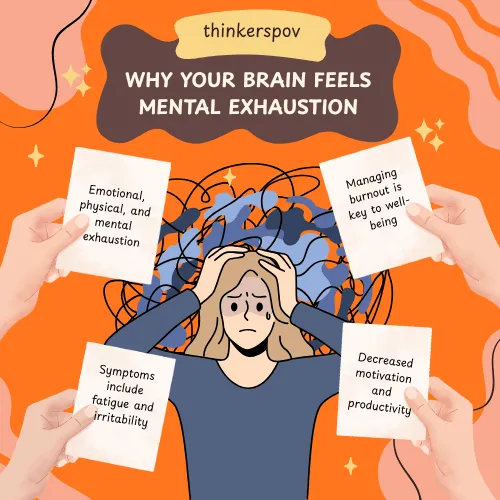
Have you ever sat down to work, study, or even do something incredibly simple—like reply to a text—and immediately felt a wave of profound tiredness?
It is not a physical tiredness. Your muscles do not ache, and you did not just run a marathon.
Instead, it is a deep, sluggish weight inside your skull.
Like your brain is carrying a heavy, invisible load all the time.
If this sounds familiar, you are not alone. Thousands of people describe this exact sensation using phrases like:
- “My brain feels heavy”
- “I feel mentally exhausted all the time”
- “Even the smallest tasks feel like climbing a mountain”
- “I am tired despite doing almost nothing”
In cognitive science and clinical psychology, this is called mental exhaustion (or cognitive fatigue). It is a very real, biological state that alters how your brain processes information, manages emotions, and initiates actions.
Understanding why your brain feels heavy is the crucial first step toward clearing the fog and reclaiming your energy.
Quick Answer (IMPORTANT) Mental exhaustion is a state where your brain feels constantly tired due to prolonged stress, overthinking, emotional pressure, or lack of real mental rest. It makes even simple tasks feel heavy and difficult.
Key Takeaways
- Mental exhaustion is caused by long-term stress, overthinking, and emotional pressure.
- It can make simple tasks feel heavy and overwhelming.
- Lack of real recovery increases mental fatigue.
- Reducing task size and mental load helps recovery.
- It is a psychological state, not a sign of failure.
What Does a Heavy Brain Feeling Actually Mean?
When people say their brain feels heavy, they are usually experiencing a combination of:
- Cognitive overload: An inability to take in or process new information.
- Persistent rumination: An active, uncontrollable loop of thoughts running in the background.
- Executive dysfunction: Struggling to plan, focus, make decisions, or initiate tasks.
- Sensory sensitivity: Feeling easily overwhelmed by noise, bright lights, or digital screens.
It is important to know that a heavy brain does not automatically mean there is a physical injury or structural damage.
Instead, it is a biological protective signal.
Just as physical pain warns you to stop using an injured muscle, the heavy, foggy feeling is your prefrontal cortex's way of crying out for rest. Your brain is telling you that its cognitive RAM is entirely full, and it has been carrying more pressure for too long than its neurochemical energy budgets can sustain.
The Cognitive Science: Why Mental Exhaustion Happens
Mental exhaustion does not build overnight. It is a slow, cumulative process of energy depletion.
To understand why you feel mentally tired, we have to look at how the brain manages its energy. The brain accounts for only about 2% of your body weight, yet it consumes roughly 20% of your body's total energy and glucose. The prefrontal cortex—the area responsible for logical thinking, decision-making, and self-control—is the most energy-expensive part of the brain.
When you push your brain too hard without proper recovery, it enters a state of resource depletion. Here are the four main catalysts behind this heavy-brain feeling:
1. Constant Stress (Sympathetic Dominance)
When you stay in problem-solving mode for too long, your nervous system remains in sympathetic dominance (the "fight-or-flight" response).
Even when you are resting, your brain is actively scanning for threats, calculating scenarios, and pumping out low levels of cortisol and adrenaline. This chronic stress consumes energy continuously. Your brain is essentially running an expensive background application 24/7, leaving very little processing power for your actual life.
2. Too Much Overthinking (Invisible Work)
Overthinking creates massive amounts of invisible work.
Your brain does not distinguish between a real physical threat and a simulated mental threat. When you ruminate on a past conversation or catastrophize a future meeting, your amygdala reacts as if the danger is happening right now.
This constant mental simulation burns glucose and depletes your neurotransmitters (like dopamine and norepinephrine), leaving you feeling completely drained even if you did nothing but sit on the couch.
Overthinking often increases mental load, draining key neurochemical stores and locking you in an exhaustive loop. Furthermore, mental fatigue can worsen at night when daily distractions fade, causing racing thoughts that prevent peaceful sleep.
3. Emotional Pressure (Emotional Exhaustion)
Family tension, financial worry, career uncertainty, and relationship stress require enormous amounts of executive processing power.
Emotional exhaustion occurs when the emotional demands placed on you exceed your psychological capacity. Because your brain has to constantly regulate, suppress, or analyze these heavy feelings, it has fewer cognitive resources left for focus and productivity.
Furthermore, carrying the weight of emotional disconnection can quietly drain your nervous system. In my article on Why You Feel Lonely Even When Surrounded by People, I explore how carrying unexpressed emotions and social disconnect acts as a silent tax on your daily mental energy. When your internal state is out of sync with your external reality, the brain works overtime to bridge the gap. Understanding the balance between internal and external self-awareness can help you identify these hidden cognitive drains.
4. Lack of Real Recovery (The Illusion of Rest)
This is where most people get stuck.
We assume that lying in bed while scrolling social media, watching television, or checking emails is "rest." In reality, this is highly stimulating active input.
Scrolling exposes your eyes to high-intensity blue light and subjects your brain to rapid-fire dopamine hits and micro-emotional triggers (envy, outrage, comparison). While your body is still, your visual cortex, reward pathway, and prefrontal cortex are working overtime. Your brain is never allowed to enter its natural recovery state.
The Shrinking Energy Budget: Why Small Tasks Feel Massive
One of the most frustrating aspects of being mentally exhausted is how it changes your perception of simple activities.
Tasks that once felt effortless—like opening your laptop, answering a message, deciding what to eat, or starting a work project—suddenly feel incredibly difficult.
This is not laziness. It is a biological constraint known as ego depletion and cognitive capacity reduction.
The Spiral of Mental Fatigue
Chronic Stress & Overthinking
The sympathetic nervous system locks in hypervigilance. Relentless internal simulations consume vital energy resources while you believe you are resting.
Neurochemical Depletion
Active glucose reserves in the brain dry up. Critical neurotransmitters like dopamine and norepinephrine drop, leading to sluggish cellular communication.
Prefrontal Cortex RAM Overload
Working memory is overloaded with uncompleted cognitive loops, emotional pressures, and digital inputs. The brain's processing capacity is fully occupied.
Cognitive Capacity Shrinks
Your brain adapts by shrinking its daily energy budget to protect itself. The total pool of cognitive resources available for activation shrinks significantly.
High Activation Energy Barrier
Because the total pool is tiny, minor routine tasks (e.g., replying to emails or opening the laptop) now require a massive percentage of your remaining capacity.
Procrastination & Mental Paralysis
As a final biological defense mechanism, your brain triggers intense resistance to prevent you from spending what little neurochemical capital is left.
When your brain is healthy and rested, you have a large energy budget. A small task like writing an email uses 2% of that budget.
But when you are mentally exhausted, your baseline energy budget shrinks. That same email now requires 40% of your remaining cognitive reserve. The brain, recognizing this critical resource shortage, creates intense feelings of resistance (procrastination) to prevent you from spending what little energy you have left.
This connects to task difficulty and emotional paralysis—where even standard routines trigger intense avoidance behaviors as a protective shell. It is a biological survival mechanism to force you to slow down.
6 Warning Signs You Are Mentally Exhausted
Mental exhaustion manifests through both cognitive and behavioral changes. You might notice:
- Severe Brain Fog: Struggling to find simple words, remember basic details, or follow a conversation.
- Elevated Overthinking: Feeling trapped in continuous, unproductive worry loops that you cannot switch off.
- Low Cognitive Stamina: Feeling completely wiped out after just 15–20 minutes of light intellectual work.
- Friction with Small Tasks: Experiencing intense dread or procrastination over minor, daily decisions.
- Irritability and Emotional Volatility: Finding yourself losing patience or feeling tearful over minor setbacks.
- Desire for Complete Isolation: Wanting to pull away from friends, family, and digital communication to stop processing social inputs.
How to Reduce Mental Exhaustion: A Step-by-Step Recovery Blueprint
You cannot cure mental exhaustion by trying to force more productivity, drinking more caffeine, or criticizing your lack of discipline. You must change the operating conditions of your brain.
Here is a practical, science-backed approach to lighten your mental load:
1. Radically Reduce Task Size
When your brain feels heavy, the cognitive friction to start a task is incredibly high. To bypass this, shrink the task until the friction disappears.
Instead of writing: "I need to work on my project for two hours." Reframe it as: "I will open my laptop and write one sentence."
This is not about tricking yourself; it is about reducing the initial activation energy required by your prefrontal cortex. Once you take the first tiny action, momentum takes over, and the task feels significantly lighter.
2. Stop Constant Self-Evaluation
Constantly measuring, judging, and analyzing your own productivity is an incredibly expensive cognitive process.
Every time you ask yourself: "Why am I so slow today? Why can't I focus? What is wrong with me?" you are loading your brain with meta-cognitive work. Give yourself permission to have a low-energy day. Accepting your current mental capacity actually preserves the precious energy you need to recover.
3. Create "Zero-Input" Recovery Moments
To allow your brain's default mode network to rest and rebuild its neurochemical reserves, you must build micro-breaks into your day that involve absolutely zero digital input.
- Walk without audio: Take a 10-minute walk without listening to a podcast or music. Let your mind drift.
- Sit in silence: Sit quietly in a chair away from all screens for 5 minutes.
- Do physical stretches: Shift your focus from abstract thoughts in your head to physical sensations in your body.
If you struggle to step away from your devices even when you are exhausted, my guide on How I Stay Focused in the Digital Age Without Quitting Technology offers practical frameworks for managing digital inputs and protecting your attention span.
4. Close Open "Cognitive Tabs" (The Brain Dump)
Just as too many open tabs will crash your computer's browser, carrying unfinished tasks, worries, and half-formed ideas in your head will crash your brain.
Take 5 minutes to write down absolutely everything bouncing around in your mind onto a blank sheet of paper. Write down tasks, worries, people you need to text back, and things you are stressed about.
Externalizing this information tells your brain: "I have recorded this. I do not need to spend energy keeping this active in my working memory."
5. Build Momentum Slow and Low
When recovering from severe cognitive fatigue, do not attempt to make massive, sweeping lifestyle changes.
Start with one small, repeatable action. Clean one corner of your desk. Drink a glass of water. Do one light stretch. Build your neural resilience slowly, allowing your brain to regain its sense of competence and control without triggering the alarm systems of an already overloaded nervous system.
Final Thoughts
If your brain feels heavy all the time, it does not mean you are lazy, weak, or failing at life.
It simply means your mind has been carrying more pressure, noise, and emotional weight than your biological systems were built to process at one time. This is often part of a larger pattern called mental overload, where your brain stays in a constant state of stress response.
Mental exhaustion makes simple things feel incredibly difficult—but difficult does not mean impossible, and it certainly does not mean permanent.
Recovery starts much smaller than most people think. By closing a few mental tabs, stepping away from the digital noise, and giving yourself permission to do less, you allow your brain to do what it does best: naturally restore its clarity, focus, and peace. When mental clarity returns, flow state becomes possible, letting you transition back to highly satisfying, productive sessions without the heavy weight.
One of the most underrated reasons brains stay heavy long-term is low self-awareness — the inability to notice accumulating stress, name emotions precisely, or recognize the patterns that keep the load building. In our Complete Guide to Self-Awareness, we explain the foundations of self-knowledge, and our deep dive on how to become more self-aware covers the specific habits that build this capacity. A daily self-awareness meditation practice is one of the most direct ways to begin closing the gap between stress accumulation and conscious recognition. If you suspect you're struggling, review the signs of low self-awareness to identify what might be holding you back.
Related Reading
- Complete Guide to Self-Awareness
- Self-Awareness Meditation: How Mindfulness Helps You Understand Yourself Better
- How to Stop Overthinking at Night
- How to Become More Self-Aware
- Signs of Low Self-Awareness
Frequently Asked Questions
Mental exhaustion often comes from long-term stress, overthinking, emotional pressure, and lack of proper mental rest.
Yes. Many people experience it during periods of stress, burnout, or emotional overload.
Recovery usually involves reducing mental load, taking real breaks, and starting tasks in smaller steps.
Yes. Overthinking increases mental workload even when no physical work is being done.
Although the brain itself does not have pain receptors, mental exhaustion is closely linked to elevated tension in the muscles surrounding your skull, neck, and shoulders due to chronic stress. Additionally, intense cognitive load increases blood flow and metabolic activity in the prefrontal cortex, which, combined with mild dehydration and eye strain from screens, creates a subjective sensation of physical pressure or 'heaviness' inside your head.
Physical tiredness is resolved with sleep and physical rest, as your muscles recover and metabolic waste is cleared from your body. Mental exhaustion is cognitive and emotional fatigue; it is a depletion of prefrontal cortex resources and key neurotransmitters like dopamine. Lying in bed will not solve mental exhaustion if you continue to ruminate or scroll on your phone. It requires cognitive rest, sensory deprivation, and 'zero-input' periods.
Yes, absolutely. Because the brain controls the autonomic nervous system, severe cognitive fatigue and chronic stress trigger the release of inflammatory cytokines and keep your body in a low-grade fight-or-flight state. This frequently manifests physically as tension headaches, chronic muscle tightness, digestive issues, mild nausea, and extreme susceptibility to sensory overload.
For daily exhaustion, a few solid 'zero-input' breaks and a good night's sleep can restore cognitive function within 24 to 48 hours. However, if you are recovering from chronic burnout that has built up over months, it can take anywhere from a few weeks to several months of consistent stress reduction, boundary setting, and nervous system regulation to fully restore your brain's baseline focus and stamina.
Because social media scrolling is not passive; it is an active, rapid-fire sensory process. Every post, video, and image forces your brain to process new visual data, evaluate social context, and react with micro-emotions (e.g., amusement, worry, comparison). This constant context switching, combined with the blue light emitting from screens, keeps your prefrontal cortex working and depletes your dopamine stores, making you feel significantly more exhausted than before you started scrolling.