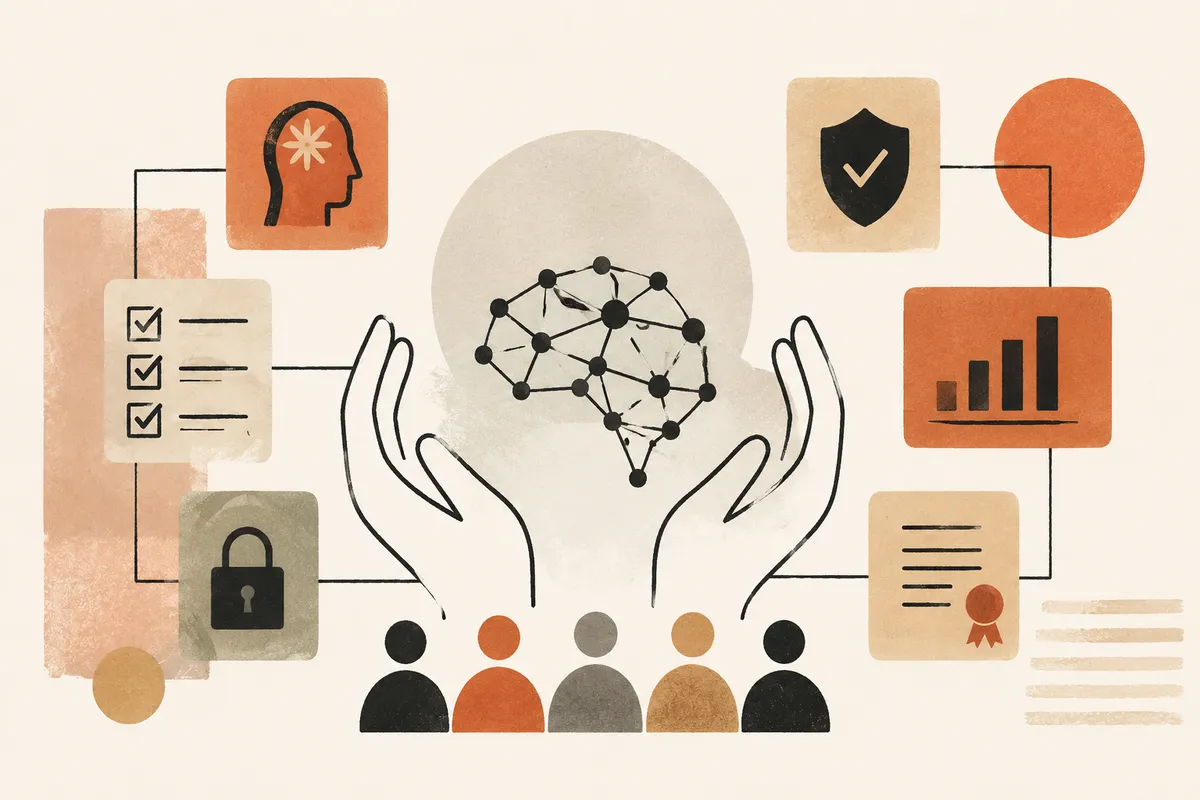
Artificial intelligence is growing fast. Most companies are now using AI in areas like customer support, finance, healthcare, HR, cybersecurity, and analytics.
But here’s the problem.
As AI usage grows, so do the risks.
Companies now need to deal with things like:
- Data privacy issues
- Security risks
- Bias in AI models
- Compliance rules
- Accountability problems
And honestly, managing all of this manually is almost impossible.
That’s where AI governance tools come in.If you're a small business just getting started, read our AI Governance Checklist for Small Businesses first — it will help you understand what you actually need before investing in any platform.
These tools help companies stay in control of their AI systems. They make it easier to track what AI is doing, manage risks, and stay compliant with regulations.
What Are AI Governance Tools?
AI governance tools are software platforms that help companies manage AI systems from start to finish.
They help teams:
- Set rules for how AI should be used
- Track AI models and systems
- Monitor AI behavior
- Keep records for audits and compliance
- Manage risks like bias or data leaks
- Organize all AI systems in one place
In simple terms:
They are like a control center for AI inside a company.
Without them, AI systems can become messy, untracked, and risky.
That’s why more companies are starting to adopt them.
How We Compared These Tools
We didn’t just list random tools. We compared them based on real buying factors that matter in companies.
Here’s what we looked at:
1. Features
We checked what each tool actually does, like model tracking, governance workflows, risk monitoring, audit logs, and policy enforcement.
2. Compliance Support
We looked at how well each tool helps companies follow rules like privacy laws (GDPR, CCPA), industry-specific regulations, internal company policies, and emerging AI safety standards (like the EU AI Act).
3. Enterprise Readiness
We checked if the tool works well for large companies. This includes scalability, security, integrations with other systems, and deployment options (cloud or hybrid).
4. Pricing
Most of these tools don’t show public pricing. So we marked pricing as Custom (for enterprise quotes). When possible, we also considered how easy or hard it is to understand the cost.
5. Ease of Use
Some tools are easy to start with. Others need full enterprise setup. We considered how quickly a team can actually start using them.
Quick Comparison Table
Here’s a simple breakdown of all the tools:
| Tool | Best For | Pricing | Compliance Strength | Deployment |
|---|---|---|---|---|
Microsoft Purview | Large enterprises | Custom | High | Cloud |
OneTrust AI Governance | Privacy and compliance teams | Custom | High | Cloud |
IBM watsonx.governance | Large AI teams | Custom | High | Hybrid |
ServiceNow AI Control Tower | Workflow-heavy companies | Custom | Medium-High | Cloud |
Domino Enterprise AI Platform | ML engineering teams | Custom | High | Hybrid |
ModelOp Center | Model governance at scale | Custom | High | Hybrid |
Holistic AI | Responsible AI programs | Custom | Medium | Cloud |
Sprinto | Compliance-focused startups | Custom | Medium | Cloud |
Trustible | AI governance workflows | Custom | High | Cloud |
Relyance AI | Privacy-focused companies | Custom | Medium-High | Cloud |
Deep Dive: The Top 10 AI Governance Tools
1. Microsoft Purview
Microsoft Purview is mainly built for large companies that already use Microsoft products. It helps organizations manage data, AI systems, and compliance in one place. If a company is already using Microsoft tools, Purview usually fits in very easily.
What it’s good at:
- Tracking AI and data usage across systems
- Managing compliance rules
- Keeping audit records
- Organizing enterprise data and AI assets
Who should use it:
- Large enterprises
- Companies already using Microsoft ecosystem
- Teams that need strong compliance control
Pricing: Custom pricing (based on enterprise needs)
Downsides:
- Can feel complex for smaller teams
- Not beginner-friendly
Simple verdict: Best choice for big organizations already inside the Microsoft ecosystem.
2. OneTrust AI Governance
OneTrust is focused heavily on privacy and compliance. It helps companies manage AI risks, policies, and governance workflows in a structured way.
What it’s good at:
- AI risk assessments
- Privacy and compliance management
- Policy and workflow automation
- AI usage tracking
Who should use it:
- Privacy teams
- Compliance-focused companies
- Enterprises handling sensitive data
Pricing: Custom pricing
Downsides:
- Can feel heavy for small teams
- Requires setup effort
Simple verdict: Best for companies where privacy and compliance matter most.
3. IBM watsonx.governance
IBM’s solution is designed for managing AI at a large scale. It focuses on monitoring models, managing risk, and keeping AI systems under control.
What it’s good at:
- AI model monitoring
- Risk and compliance tracking
- Full AI lifecycle governance
- Bias and fairness checks
Who should use it:
- Large enterprises
- Regulated industries like finance or healthcare
- Teams running many AI models
Pricing: Custom enterprise pricing
Downsides:
- Not simple to set up
- Better for large teams only
Simple verdict: Strong option for enterprise-level AI governance and lifecycle control.
4. ServiceNow AI Control Tower
ServiceNow focuses on workflow-based governance. It helps companies manage AI operations using automated processes and approvals.
What it’s good at:
- Workflow automation
- AI governance approvals
- Risk tracking
- Centralized AI monitoring
Who should use it:
- Companies already using ServiceNow
- Large operations teams
- Workflow-heavy organizations
Pricing: Custom pricing
Downsides:
- Works best inside ServiceNow ecosystem
- Not standalone-focused
Simple verdict: Best for companies that rely heavily on workflow automation.
5. Domino Enterprise AI Platform
Domino is mainly used by data science and ML teams. It helps manage AI models from development to deployment with better control and visibility.
What it’s good at:
- AI model lifecycle tracking
- Experiment management
- Collaboration between teams
- Deployment control
Who should use it:
- Data science teams
- ML engineers
- Enterprises scaling AI systems
Pricing: Custom pricing
Downsides:
- More technical than compliance-focused tools
- Needs engineering setup
Simple verdict: Best for teams building and managing AI models actively.
6. ModelOp Center
ModelOp is built specifically for AI governance. It focuses on controlling, tracking, and managing AI models in enterprise environments.
What it’s good at:
- Model registry and tracking
- Governance workflows
- Risk and compliance reporting
- Audit-ready documentation
Who should use it:
- Large enterprises
- Regulated industries
- Dedicated AI governance teams
Pricing: Custom pricing
Downsides:
- Enterprise-only
- Requires structured AI processes
Simple verdict: One of the most focused AI governance platforms available.
7. Holistic AI

Holistic AI focuses on responsible AI. It helps companies identify risks like bias, fairness issues, and compliance gaps.
What it’s good at:
- Bias and fairness detection
- AI risk assessments
- Compliance monitoring
- Responsible AI reporting
Who should use it:
- Companies focused on ethical AI
- Compliance and risk teams
- Organizations building AI policies
Pricing: Custom pricing
Downsides:
- Not a full lifecycle platform
- Focused more on risk than operations
Simple verdict: Best for responsible AI and risk analysis.
8. Sprinto
Sprinto is mainly a compliance automation tool. It helps companies stay audit-ready and manage security and compliance processes.
What it’s good at:
- Automated compliance tracking
- Audit preparation
- Risk dashboards
- Policy management
Who should use it:
- Startups
- SaaS companies
- Fast-growing teams
Pricing: Subscription-based (varies by plan)
Downsides:
- Not built specifically for AI governance
- Limited deep AI controls
Simple verdict: Good for compliance, not deep AI governance.
9. Trustible
Trustible helps companies manage AI governance in a structured way. It focuses on evaluating AI use cases and managing risks before deployment.
What it’s good at:
- AI use case evaluation
- Risk assessment workflows
- Governance documentation
- Compliance reporting
Who should use it:
- Companies building AI governance programs
- Enterprises scaling AI usage
- Policy-driven organizations
Pricing: Custom pricing
Downsides:
- Smaller ecosystem
- Still growing platform
Simple verdict: Good for structured AI governance from the ground up.
10. Relyance AI
Relyance AI focuses heavily on data privacy. It helps companies track how data is used across AI systems and ensures compliance.
What it’s good at:
- Data mapping
- Privacy tracking
- Compliance monitoring
- Risk visibility
Who should use it:
- Privacy-focused companies
- Data-heavy AI systems
- Regulated industries
Pricing: Custom pricing
Downsides:
- Limited full AI lifecycle features
- More privacy-focused than AI governance
Simple verdict: Best for companies where data privacy is the main concern.
How to Choose the Right Tool
When selecting an AI governance platform, consider the following roadmap:
- Identify your main pain point: If your biggest concern is privacy law, look at OneTrust or Relyance AI. If it is engineering quality, look at IBM or Domino.
- Review your existing stack: If you are a heavy Microsoft shop, Microsoft Purview is a natural choice.
- Assess team expertise: Startups should look at compliance automation tools like Sprinto, while large enterprises with dedicated risk teams will benefit from ModelOp or Holistic AI. Not sure where you fit? Start with our AI Governance Checklist for Small Businesses.
AI governance is no longer optional. Choosing the right tool today will save your organization from security incidents, regulatory fines, and reputational damage tomorrow.
Not sure where to start? Before picking any tool, work through our AI Governance Checklist for Small Businesses — it takes one afternoon and costs nothing. If you want to understand the full structural framework first, read our deep-dive on AI Governance Frameworks Explained, covering the five core layers, lifecycle stages, and real-world implementation patterns.
Frequently Asked Questions
AI governance is the process of managing how AI systems are built, deployed, and monitored to ensure compliance, safety, and responsible usage.
Because AI systems introduce risks such as bias, data leaks, compliance violations, and lack of transparency.
No, but most platforms are designed with enterprise complexity in mind.
Most tools use custom enterprise pricing depending on scale and requirements.