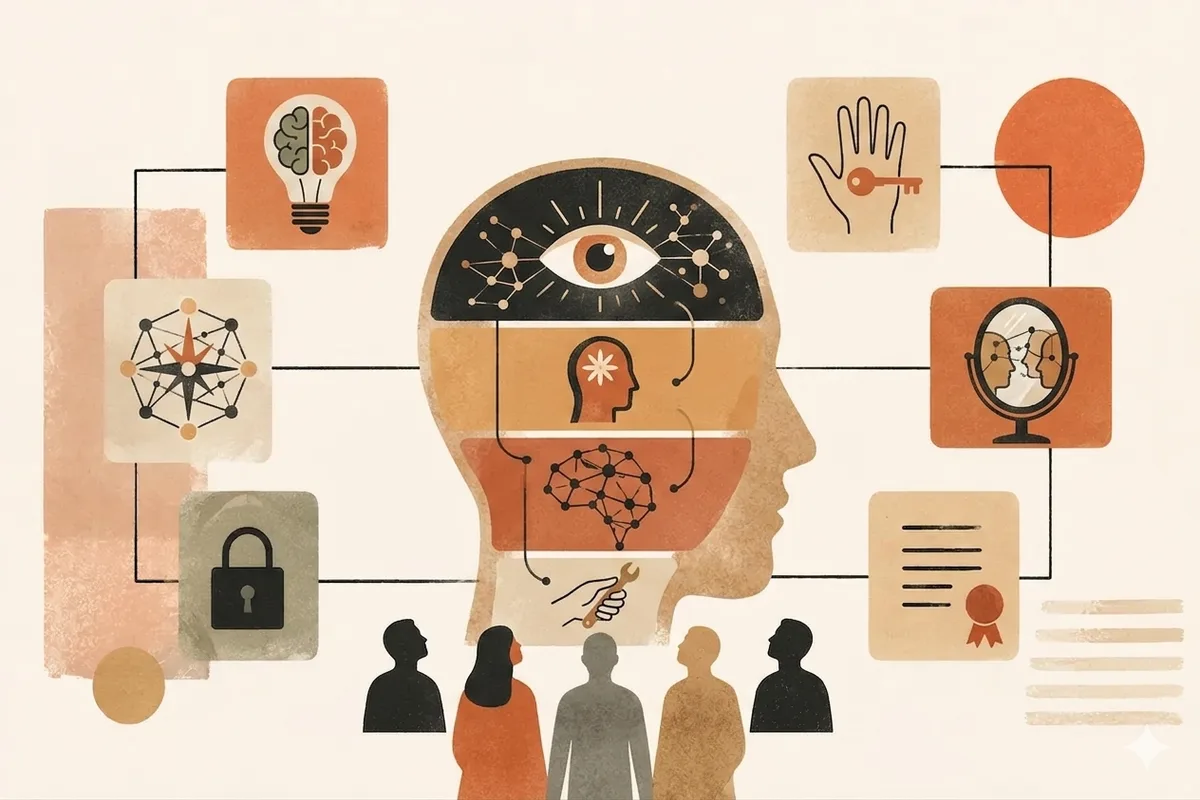
There are 4 levels of awareness that determine how clearly you see yourself, other people, and the world around you. Most people spend their entire lives at the first two. They consume information constantly, form confident opinions, and make decisions — all without ever pausing to examine what they actually know versus what they only think they know.
That distinction, between genuine understanding and the illusion of it, is at the heart of what separates clear thinking from self-deception.
Psychology has explored this through competence frameworks and self-awareness models for decades. But most people brush past it without letting it actually land. Here is the full breakdown.
What this article covers
- What awareness actually means
- Level 1 — What You Know You Know (Conscious Competence)
- Level 2 — What You Know You Don't Know (Conscious Incompetence)
- Level 3 — What You Don't Know You Don't Know (Unconscious Incompetence)
- Level 4 — What You Think You Know But Don't (False Knowledge)
- How to move between levels
- Frequently asked questions
Level 1 — What You Know You Know (Conscious Competence)
This is the most familiar layer of awareness. These are the skills, experiences, and knowledge areas you are fully conscious of. You have tested them in real life. You have practised them. You trust them.
Think about:
- speaking your native language without effort
- navigating your city without a GPS
- knowing your way around tools you have used for years
This zone feels comfortable. Confidence flows naturally here because the competence has already been earned through repetition and direct experience.
But here is what I have noticed — staying only in this space creates a slow kind of intellectual stagnation. Comfort is nice. Growth is not always comfortable.
Level 2 — What You Know You Don't Know (Conscious Incompetence)
This level gets underrated, but I think it is genuinely important.
These are the subjects, skills, and areas you know you have not figured out yet. You are aware of the gap. You can name it.
Maybe it is:
- how machine learning actually works under the hood
- a language you have never studied
- a domain like neuroscience or economics that feels completely foreign
On the surface, this feels uncomfortable. Nobody enjoys sitting with their own ignorance.
But I would argue this is actually a healthy place to be — because awareness of limitation is what makes growth possible. The moment you can clearly see what you do not understand, curiosity kicks in.
This is where real learning starts.
Level 3 — What You Don't Know You Don't Know (Unconscious Incompetence)
This one is the most dangerous layer. And in a world flooded with information, I think it is becoming more common, not less.
These are your true blind spots. The perspectives, ideas, and realities that you have never considered — not because you rejected them, but because they never entered your awareness in the first place.
You cannot question what you cannot see. You cannot challenge assumptions you do not know you are making.
This is exactly what Socrates was pointing toward when he said that the wisest person is the one who knows they know nothing. It sounds like a paradox. But it is actually one of the most psychologically honest statements ever made.
In modern life, unconscious incompetence shows up in subtle ways — in conversations where someone is completely confident but entirely wrong, in decision-making shaped by biases no one ever examined, in worldviews built on information that was never challenged.
The antidote is not more data. It is genuine intellectual humility — the willingness to ask what am I not seeing here?
Level 4 — What You Think You Know But Don't (False Knowledge)
This might be the most psychologically interesting category of all. And in the age of social media and algorithmic content, it might also be the most widespread.
False knowledge is when the mind becomes convinced something is true, even when the foundation underneath it is shaky, incomplete, or entirely wrong.
It is the illusion of understanding without the substance.
You see it constantly:
- opinions formed from a 60-second video
- confident takes built on misread headlines
- assumptions about complex topics shaped by a few viral posts
- stereotypes that were never examined
The dangerous part is not ignorance. The dangerous part is that false knowledge feels like real knowledge from the inside. There is no obvious signal telling you something is wrong. The certainty feels completely genuine.
And modern digital culture makes this worse. The information environment is designed for speed, not depth. We consume more than ever. But consuming is not the same as understanding.
How to Move Between Levels of Awareness
I genuinely think the relationship between people and knowledge has changed in ways most of us have not processed yet.
We live in a world where information is essentially infinite. You can find an answer to almost anything within seconds. But access to information has never automatically created understanding.
What actually creates understanding is:
- slowing down enough to reflect
- being willing to sit with uncertainty
- questioning the things you already believe
- developing curiosity about your own blind spots
Without those things, information just becomes noise. And in an attention economy that profits from keeping you stimulated rather than helping you think clearly, developing real metacognitive awareness — thinking about your own thinking — is one of the most valuable things you can do.
The most intellectually honest people I have encountered — the ones who are genuinely sharp and thoughtful — tend to ask more questions than they answer. They hold their opinions with a kind of confident looseness. They are comfortable saying I am not sure or I had not considered that.
That does not make them less confident. It makes them more trustworthy.
Self-awareness is the foundation that holds everything else up. Not productivity hacks. Not more information. Not faster thinking.
Just the consistent practice of asking: What do I actually know? What am I assuming? And what am I completely failing to see?
Those questions do not always have clean answers.
But asking them is how you start thinking at a level most people never reach. (To move beyond this theoretical framework and start building genuine internal and external self-knowledge, you can read my complete roadmap in The Complete Guide to Self-Awareness).
Many blind spots persist because people develop strong internal awareness while neglecting external awareness. Both dimensions are necessary to accurately understand yourself and reduce false assumptions.
If you are ready to act on these ideas immediately, 9 Science-Backed Habits to Become More Self-Aware gives you the concrete daily practices — the specific exercises that move you from Level 3 and Level 4 awareness toward genuine clarity. If you're concerned that your current level of awareness is holding you back, check out the signs of low self-awareness to identify potential blind spots.
Related Reading
- Complete Guide to Self-Awareness
- How to Become More Self-Aware
- Signs of Low Self-Awareness
- Why Most People Never Change
- How to Stop Overthinking at Night
- Why Your Brain Feels Heavy All The Time
Frequently Asked Questions
The 4 levels of awareness are Conscious Competence, Conscious Incompetence, Unconscious Incompetence, and False Knowledge. Each level represents a deeper capacity to observe your own thinking, emotions, and assumptions. Most people operate at level 1 or 2 without realising there is something deeper available.
Awareness is the ability to notice what is happening — around you and within you. Self-awareness specifically means turning that attention inward: recognising your own thought patterns, emotional reactions, biases, and blind spots. Self-awareness is a subset of awareness, and it sits at the higher levels of the framework described in this article.
Intelligence is often thought of as a fixed capacity, but research in cognitive science suggests that how clearly you perceive a situation — how aware you are of your assumptions, emotions, and gaps in knowledge — directly shapes the quality of your thinking and decisions. Awareness does not raise your IQ, but it sharpens how you use whatever intelligence you have.
Some psychological frameworks describe 5 levels of self-awareness. This article focuses on 4 core levels because they map most directly to practical changes in thinking and behaviour. The additional level in 5-level models typically refers to transcendent or observer-level awareness, which is touched on in Level 4 of this framework.
Moving between levels of awareness is not a matter of trying harder — it is a matter of exposure and reflection. Reading philosophy, practising mindfulness, receiving honest feedback, and deliberately questioning your assumptions are all pathways that have been shown to expand awareness over time.